Underground Fully Welded Ball Valve
Underground Fully Welded Ball Valve is selected for buried pipeline installations requiring stem extension, external coating and above-ground operating access. An underground fully welded ball valve is configured for buried installation with an extended stem, drain/vent extension and project-specific external coating. Burial depth, actuator or gearbox access, cathodic protection interface and coating repair requirements must be defined before manufacture.
Underground Fully Welded Ball Valve for industrial valve projects.
An underground fully welded ball valve is configured for buried installation with an extended stem, drain/vent extension and project-specific external coating. Burial depth, actuator or gearbox access, cathodic protection interface and coating repair requirements must be defined before manufacture.
When to select this design
Buried pipeline installations requiring stem extension, external coating and above-ground operating access.
Choose this design when the valve body remains buried and the operator interface must be brought above grade.
Typical applications
- Buried gas pipelines
- Cross-country pipelines
- City gas networks
- Remote sectionalizing stations
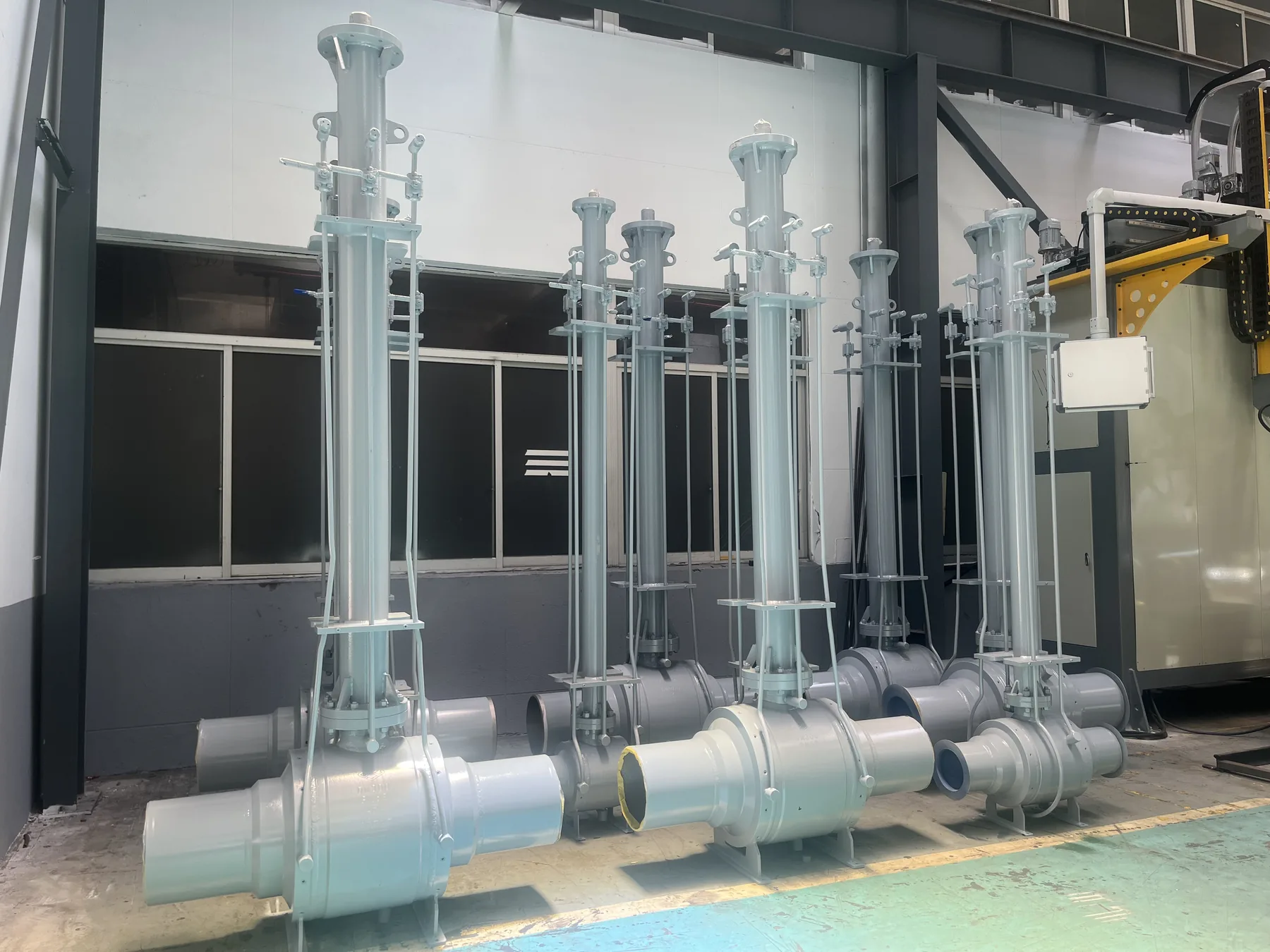
Underground Fully Welded Ball Valve: design points to confirm.
This is a specific valve construction. Final size, class, material and seat combinations depend on the approved datasheet and design calculation.
| Body construction | A fully welded trunnion body is adapted for buried service so the pressure-containing body can remain underground while the stem and operator interface extend to grade level. |
|---|---|
| Seat & sealing | Pipeline seat design is selected according to pressure direction, DBB/DIB requirement and media. Long-term stem sealing and cavity vent/drain extension design are especially important for buried valves. |
| End connection | Butt-weld ends are common for cross-country pipelines. The piping designer should confirm weld-end dimensions, burial depth, stem extension and above-ground operator arrangement. |
| Engineering focus | Define burial depth, extension tube length, gearbox/actuator mounting, drain/vent extension, groundwater exposure, cathodic protection interface and access for future operation. |
| Material selection | External coating system and corrosion protection are as important as pressure-shell materials. Coating around weld areas, stem extension and buried accessories should be specified. |
| Testing & inspection | Complete pressure testing and functional checks before burial. Project inspection may include coating holiday testing, DFT checks, weld NDE and verification of extension dimensions. |
Engineering considerations for Underground Fully Welded Ball Valve.
Construction and maintenance
A fully welded trunnion body is adapted for buried service so the pressure-containing body can remain underground while the stem and operator interface extend to grade level.
Seat, sealing and torque
Pipeline seat design is selected according to pressure direction, DBB/DIB requirement and media. Long-term stem sealing and cavity vent/drain extension design are especially important for buried valves.
Piping and installation
Butt-weld ends are common for cross-country pipelines. The piping designer should confirm weld-end dimensions, burial depth, stem extension and above-ground operator arrangement.
What to verify before approving the technical offer.
Engineering risk
Define burial depth, extension tube length, gearbox/actuator mounting, drain/vent extension, groundwater exposure, cathodic protection interface and access for future operation.
Materials and traceability
External coating system and corrosion protection are as important as pressure-shell materials. Coating around weld areas, stem extension and buried accessories should be specified.
Inspection and testing
Complete pressure testing and functional checks before burial. Project inspection may include coating holiday testing, DFT checks, weld NDE and verification of extension dimensions.
Send the valve datasheet together with the piping class and project valve, material, testing and coating specifications. Missing design inputs should be clarified rather than assumed.
Other Fully Welded Ball Valves configurations.
Compare related designs by construction, pressure class, temperature range and service conditions.
Choose this design when long-term pressure-shell integrity and reduced body joints are stronger priorities than body disassembly.
Compare Fully Welded Trunnion Ball Valve →Choose this configuration when the application is specifically gas transmission rather than general industrial welded-body service.
Compare Gas Pipeline Fully Welded Ball Valve →Return to the Fully Welded Ball Valves range to compare all configurations.
Back to Fully Welded Ball Valves Range →Continue the technical selection.
Use these pages to check pressure class, material, standard and end-connection requirements against this valve design.
Underground Fully Welded Ball Valve FAQ
What is a underground fully welded ball valve?
An underground fully welded ball valve is configured for buried installation with an extended stem, drain/vent extension and project-specific external coating. Burial depth, actuator or gearbox access, cathodic protection interface and coating repair requirements must be defined before manufacture.
Where is a underground fully welded ball valve commonly used?
Typical applications include Buried gas pipelines, Cross-country pipelines, City gas networks, Remote sectionalizing stations. Final suitability depends on the actual service medium, pressure, temperature and project specification.
What information is needed to quote a underground fully welded ball valve?
Provide size, quantity, pressure class, body and trim materials, seat material, end connection, design pressure and temperature, media, operation, design standard, fire-safe/emission requirements, testing, coating and documentation scope.
How is a underground fully welded ball valve different from other fully welded ball valve designs?
Choose this design when the valve body remains buried and the operator interface must be brought above grade.
Technical documents for project review.
For technical evaluation, request the applicable product documents and inspection records for the offered valve configuration.
Product Photos
Additional finished-valve, nameplate and component photos are available for the selected valve configuration.
GA Drawing / Datasheet
GA drawings and datasheets are prepared for the selected size, pressure class and valve configuration.
Testing & Inspection Records
Inspection documentation can include pressure testing, dimensional inspection, PMI, NDE/NDT and coating records as required by the project.